
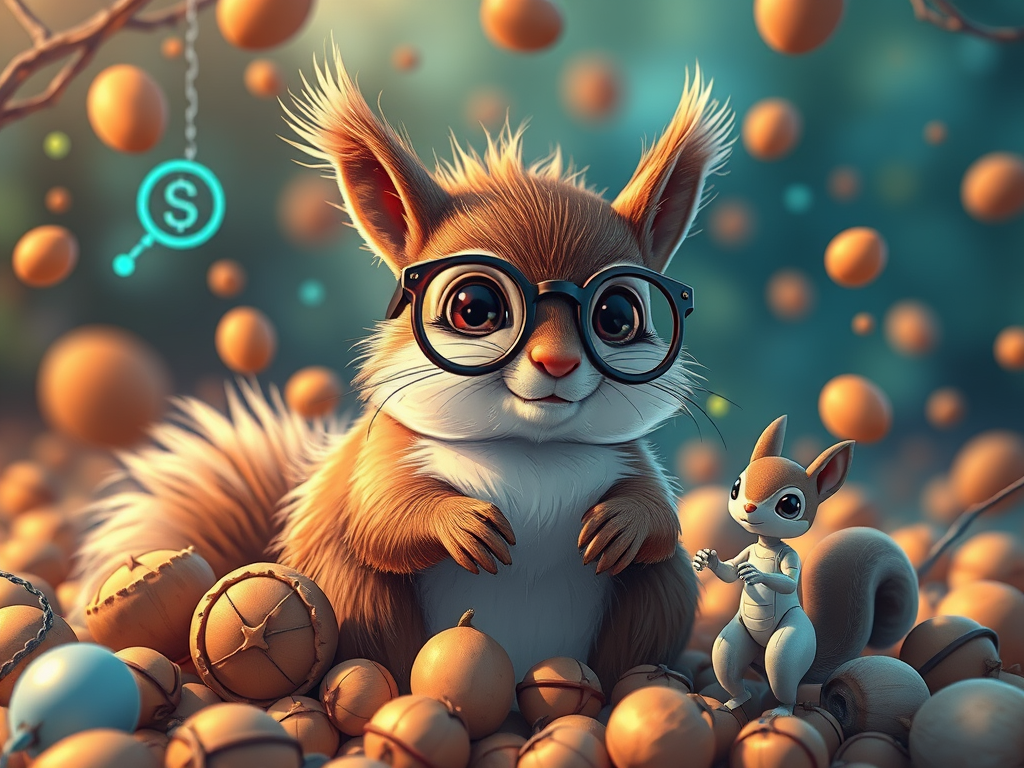

Cracking the Code of AI: Your Next Developer Superpower
Hold on to your nuts, fellow code-scroungers! I am Aran Squeaky DataNut, your resident bushy-tailed software dev, and I’m about to crack open the nut of Artificial Intelligence (AI) for you! If you’re building software, you’re already seeing AI reshaping our entire tech landscape – from how we write code to how our applications interact with the world. So, wanna know what’s really going on under the hood? This is one of my favorite topics, even more fascinating than finding the perfect acorn!
Imagine this: As a squirrel, I know how to find the tastiest nuts. I know how to climb the slipperiest trees. I can outsmart that grumpy husky next door. I’ve learned these things from experience, from trying, failing, and trying again. My little squirrel brain is always processing, always adapting.
Artificial Intelligence is basically trying to get computers to do something similar! It’s the science and engineering of making machines smart, enabling them to perform tasks that would normally need a human brain. Think of it like teaching a tiny robot squirrel to find the best nuts. I don’t need to explicitly tell it every single branch to check, or every single sniff to take; the robot learns.
Beyond Simple Rules: The Evolution of AI
It’s not just “if-then” statements anymore! For a long time, we programmers write code like: IF (nut_is_brown) THEN (pick_up_nut). But real-world problems are way more complex than that! AI goes beyond simple, hard-coded rules.
Learning from Data (The Big Heap of Nuts)
This is where the magic happens! Instead of us writing every single instruction, we feed AI systems massive amounts of data. Think of it as a gigantic pile of every nut I’ve ever seen, smelled, or cracked open. The AI then looks for patterns in that data, learning how to make decisions or predictions.
This core idea brings us to Machine Learning (ML), a huge branch of AI. It’s about building algorithms that can learn from data without being explicitly programmed for every single scenario.
- Supervised Learning: I show the robot squirrel a picture of an acorn and tell it “This is an acorn!” (labeled data). It learns to recognize acorns on its own. Real-world example: Spam filters learning to identify junk email based on thousands of pre-labeled spam and non-spam examples. Learn more about Supervised Learning here.
- Unsupervised Learning: I just give the robot squirrel a pile of mixed nuts. It figures out how to group them by type on its own. It sees patterns I didn’t point out. Real-world example: Customer segmentation. An AI groups shoppers based on their purchasing habits. It does this without being told what categories to look for. Learn more about Unsupervised Learning here.
- Reinforcement Learning: The robot squirrel tries to find a nut. If it finds one, I give it a treat! If it doesn’t, no treat. It learns through trial and error, trying to maximize its “rewards.” Real-world example: This is how self-driving cars learn to navigate by getting “rewards” for staying on the road and “penalties” for swerving, or how game-playing AIs master complex strategies. Learn more about Reinforcement Learning here.
Neural Networks and Deep Learning (The Brainy Bits)
These are inspired by how our own squirrel brains work! Imagine a network of interconnected “neurons” that process information. Deep learning is a type of machine learning that uses very deep neural networks, allowing them to learn incredibly complex patterns. For example, it can recognize a specific type of tree by its bark. This is possible even in different lighting. It can also distinguish between different breeds of dogs in images. Dive deeper into Neural Networks and Deep Learning.
What Can These “Smart Machines” Do? Real-World Applications
Oh, so many things! AI is already transforming industries and daily life.
- Computer Vision: My robot squirrel can “see” and determine if there’s a cat or a fellow squirrel. It can also check if a nut is good or rotten. For humans: This includes facial recognition on your phone. It also means self-driving cars “seeing” the road and traffic signs. Additionally, it covers medical image analysis, like detecting tumors in X-rays. Finally, it involves quality control in manufacturing.
- Natural Language Processing (NLP): If I can chatter to the robot squirrel in squeaks and chirps, and it understands me, that is an illustration of NLP. It’s how computers understand and generate human language. For humans: Consider chatbots and virtual assistants (Siri, Alexa). Think of language translation like Google Translate, ChatGPT, Gemini, Copilot. It includes sentiment analysis for understanding customer reviews. It even helps us write code comments!
- Generative AI: This is super cool! Imagine the robot squirrel. It can invent a new type of delicious nut. The invention is based on all the nuts it’s ever learned about. For humans: Generative AI can create new content, like writing stories, generating realistic images and art (e.g., Midjourney, DALL-E), composing music, or even helping us brainstorm code snippets or entire functions!
Ethical Considerations: Building Responsible AI
As developers, we’re not just building cool tech; we’re building the future. With the immense power of AI comes significant responsibility. It’s crucial to consider the ethical implications of the AI systems we create.
- Bias: AI systems learn from data. If the data is biased (e.g., primarily showing one demographic), the AI can perpetuate or even amplify that bias, leading to unfair outcomes in areas like hiring, loan applications, or even facial recognition.
- Privacy: AI often relies on vast amounts of personal data, raising concerns about how this information is collected, stored, and used.
- Transparency (Explainable AI – XAI): Sometimes, it’s hard to understand why an AI made a certain decision (“black box” problem). For critical applications like medical diagnoses or legal decisions, knowing the AI’s reasoning is vital.
- Misinformation and Misuse: Generative AI, while powerful, can be used to create deepfakes. It can also spread false information. This requires careful consideration of its deployment.
Building AI responsibly means being aware of these challenges and actively working to mitigate them. Explore AI Ethics further here.
AI: Your New Developer Toolbox
For us software developers, AI is becoming an incredible toolbox that will revolutionize how we work. It helps us:
- Write code faster: AI code suggestions and auto-completion help you write code faster. They are like having a tiny, super-fast coding assistant on your shoulder. This assistant suggests the next line or even entire functions.
- Find bugs: AI can analyze code patterns and predict where errors can occur, often before runtime, saving hours of debugging (which, let’s be honest, is as fun as a wet tail).
- Automate repetitive tasks: Imagine AI handling all the tedious configuration files, boilerplate code, or even infrastructure provisioning so we can focus on the really interesting algorithms and problem-solving.
- Analyze massive datasets: AI can chew through more data than a thousand squirrels on a caffeine rush, helping us find insights for better decision-making, optimize performance, or discover new trends.
So, in a nutshell, AI is about building intelligent systems that can learn, reason, understand, and even create, just like our own clever squirrel brains do! It’s a field that’s always evolving, and it’s making our developer lives much, much more exciting. Now, if you’ll excuse me, I hear the distinct scent of a fresh batch of binary code… and maybe a hidden almond!
Share Your Thoughts!
Whew! That was a lot of nuts to crack, wasn’t it? I hope this dive into AI has given your developer brain some new ideas to chew on.
Now it’s your turn, fellow code-scroungers! What are your thoughts on AI’s impact on development? Have you started incorporating AI tools into your workflow, or are you just getting started on your AI learning journey? Share your experiences, questions, and any cool AI tricks you’ve stumbled upon in the comments below! I’m always eager to hear from my community.
Scurries off.
 About Programming Squirrel
Leave a comment